Scripture: Luke 9:51-56; Psalm 131; Acts 8:26-31
Because every image of Jesus reveals more about us than about him, the question of faith is not what we see in Jesus but that Jesus, having turned his face to Jerusalem and the cross, has turned his face toward us and truly sees and loves us.
Illustrations: catacomb-bearded-christ, santa-pudenziana-mosaic, hagia-sophia-christ, verrocchio-leonardo-baptism, caravaggio-entombment, yoked-jesus, schweitzer-own-face, ethiopian-eunuch, devil-quotes-scripture, gospel-hinge-jerusalem, bass-drum-toward-cross, beatitudes-inversion, dim-lights-self-portrait, glass-darkly
March 2
Psalm 131
Luke 9:51-56
O Lord, my heart is not lifted up; my eyes are not raised too high; I do not occupy myself with things too great and too marvelous for me. But I have calmed and quieted my soul, like a weaned child with its mother; my soul is like the weaned child that is with me. O Israel, hope in the Lord from this time on and forevermore. - Psalm 131
When the days drew near for him to be taken up, he set his face to go to Jerusalem. And he sent messengers ahead of him. On their way they entered a village of the Samaritans to prepare for his arrival, but they did not receive him because his face was set toward Jerusalem. When his disciples James and John saw this, they said, “Lord, do you want us to command fire to come down from heaven and consume them?” But he turned and rebuked them. Then they went on to another village. - Luke 9:51-56
Images of Jesus offer us a glimpse of the society out of which they were created more so than an understanding of who Jesus is. We have over a thousand years of images of Jesus. Two thousand years If you count the stroud of Turin.
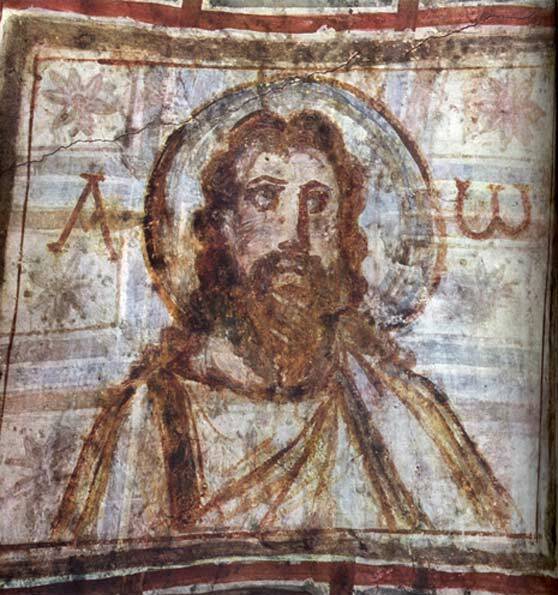 here is one of the earliest paintings of Jesus. This is from the 4th century in a catacombs in Rome. We see the beard and the alpha and the omega.
We already have a lot more majesty after Constantine’s baptism here

Here is a mosaic of Jesus from the Hagia Sophia in Istanbul made a few years later
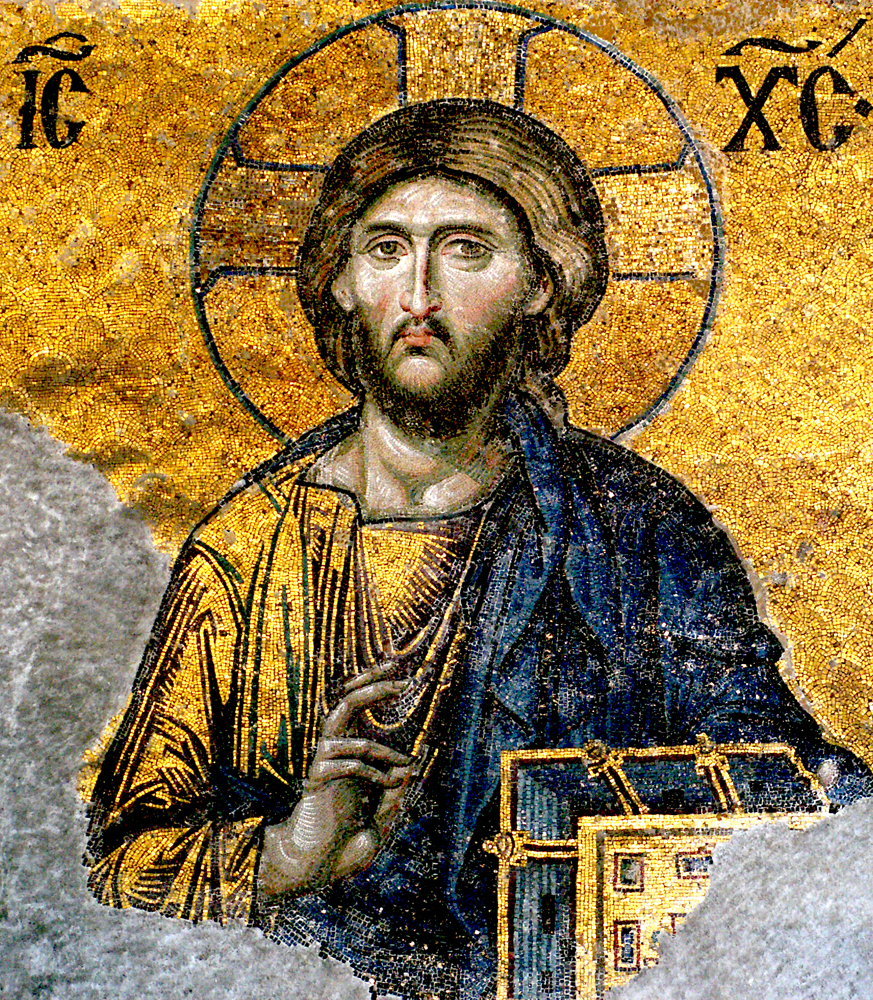
This iconographic technique lasted for the next few centuries. The artistic technique of iconography was not due to the limitations of paint, canvas, et cetera. Icons are intentionally flat so that the viewer, through prayer, will fill them out as they are drawn up to heaven. The early Renaissance period saw a shift stylistically as more realistic representations of the human body entered pictures of Jesus.
Leonardo and his master are generally ascribed this painting of the baptism of Jesus.

We see much more realism and naturalism with Jesus. We see a little bit of muscle tone.
For me, the high point of these depictions is Caravaggio in the baroque period.

Now, this isn’t an art history class. I really just wanted to show all of those pictures of Jesus to show this one.
.bd3fa7d3b7c8402688dbe996a8eb1836.gif)
Yoked Jesus. This Jesus has lats that go on forever. He is also on testosterone supplements and probably some other chemicals.
It’s not only the images of Jesus that reveal the culture around them. For the last two hundred years, scholars have tried to find the historical Jesus beneath the Jesus of faith.
Even still, as Alfred Schweitzer once said, when people look for the face of Jesus, they often see their own face looking back: a French enlightenment scholar will see a French enlightenment. Jesus, a traditionalist, Dutch Reformed scholar will find a traditionalist, Dutch Reformed Jesus, a contemporary united Methodist pastor in Austin, Texas will find a contemporary United Methodist Jesus.
We have to admit these biases when we look for Jesus. In scholarly terms, this is the difference between exegesis and eisegesis. Eisegesis is what we put into the text. Exegesis is what we take out, what we receive from the text, from scripture.
One of the reasons we should be reading the Bible together is to make sure we’re not putting too much of ourselves into the text. In the Bible, people are always reading the Bible together. Solitary Bible reading leads to questions and community. For instance, the Ethiopian Eunuch in Acts chapter 8.
26 Now an angel of the Lord said to Philip, “Rise and go toward the south to the road that goes down from Jerusalem to Gaza.” This is a desert place. 27 And he rose and went. And there was an Ethiopian, a eunuch, a court official of Candace, queen of the Ethiopians, who was in charge of all her treasure. He had come to Jerusalem to worship 28 and was returning, seated in his chariot, and he was reading the prophet Isaiah. 29 And the Spirit said to Philip, “Go over and join this chariot.” 30 So Philip ran to him and heard him reading Isaiah the prophet and asked, “Do you understand what you are reading?” 31 And he said, “How can I, unless someone guides me?” And he invited Philip to come up and sit with him.
There’s a level of accountability when we read the Bible with other people because, as the Bible shows us again and again, even the devil quotes scripture. Next week, on the first Sunday of Lent, we will talk about the temptations of Jesus in the Dessert, where the devil quotes a lot of scripture at Jesus. Just quoting scripture, just quoting Jesus doesn’t make what you say good.
All of this talk about how we see Jesus and the face of Jesus is important for us today because we’re looking at the moment when Jesus turns his face towards Jerusalem. This is the hinge of the gospels. Each of the gospels has a moment like this where Jesus’ ministry is no longer about going out, sharing the good news of the kingdom of heaven, healing, casting out demons, teaching and preaching. In each Gospel, the gravitational force of Jerusalem and Golgotha pulls Jesus back. In Mark, it is when Jesus enters Judea in Chapter 10. In Matthew, it is the beginning of chapter 19. In the Gospel of John, Jesus spends a lot more time in Jerusalem, but in Chapter 11, he visits Bethany, a village near Jerusalem, and never heads out again.
In Luke, it is chapter 9.
Jesus has now turned his face toward Jerusalem. He is on his way to his death.
Today is officially Transfiguration Sunday, though I preached about the transfiguration last week. It is the Sunday before Ash Wednesday. I wanted to preach on this text today because I think it’s a great start for the season of Lent.
We’re not in Lent yet. We can still sing our hallelujahs. We don’t have to be doing our fasts. It’s early on in the Gospel of Luke when this happens. There’s a lot that goes on after he turns his face to Jerusalem, but it’s almost as if there’s a bass drum in the background of his life after this slowly beating along: boom, boom, Boom, BOOM! Building and building up through the triumphal entry, up through his teaching and preaching in Jerusalem, up to Maundy Thursday, the last Supper, and good Friday at his crucifixion and the silence of Holy Saturday. The tension is building. The drama is building. Jesus is walking to his death out of obedience.
A lot of times, the teachings of Jesus invert our expectations. The Sermon on Mount is a great example of this. Blessed are the poor in spirit. Whoa, that’s completely different from what we expect. Happy are those who mourn. completely different from what we expect. It’s a flip, and the question of faith is not what we find in Jesus. What we find useful in Jesus, what we can take out from Jesus. But what does Jesus find in us? What does Jesus see in us? Who does Jesus see in us? Where are we headed? Where are you headed with your life? Where is your face turned?
I think that this is a major aspect, not only of the Season of Lent, but of the entire life of Christian. Where are you going? Jesus is willing to go to Jerusalem. Where are you willing to go? How far are you willing to go.
If Jesus drew a portrait of you, what would it look like?
I want us to do things a little different for the rest of this sermon. I am going to ask our tech team to dim the lights.
Close yours if you can. Imagine what would Jesus notice about you that you miss about yourself?
What would Jesus high light?
What would Jesus pass over?
You can open your eyes now.
Stay in that moment. The God who made everything became human in Jesus Christ. Jesus was perfectly obedient to the Father even to the point of turning his face to Jerusalem. In doing that, he also turned his face toward you. Right now.
In turning toward Jerusalem, Jesus has turned towards you and you and all of us. Jesus was willing to walk all the way to the cross for us. No matter how we have distorted Jesus. No matter how we have messed up. Somedays, we may have worshipped the yoked Jesus, some days the renaissance one. We try to tear down the cultural baggage placed upon God, but we are often blind to our own blind spots. And we look through a glass darkly.
We may not see Jesus as he is, but Jesus sees us. Jesus sees you. You are seen. You are loved. And you are worth walking all the way to the cross for. In the name of the Father and the Son and then Holy Spirit. Amen.